I’d choose PostHog when revenue analysis needs to sit alongside product behavior, experiments or replay. I’d consider Grosslytics for a focused source-to-payment dashboard and fee-adjusted revenue, provided you can do without those broader tools. PostHog can connect Stripe data, and not every report requires handwritten SQL.
Key takeaways
- PostHog’s free allowance includes one million analytics events monthly, so a smaller paid tool is not automatically the cheaper choice.
- Grosslytics lists $5.99/month for 100,000 hosted events, free source self-hosting and an optional $29 Lifetime license.
- The measured local Grosslytics main tracker is 3,257 bytes raw and 1,580 bytes Brotli; no equivalent PostHog configuration was benchmarked.
- Provider metadata, renewal behavior and refund coverage matter more than the time needed to paste a script tag.
When is focused revenue analytics enough?
A focused tool is enough when your recurring question is which source brought paying customers and what remained after specified costs.
Grosslytics is our product. This comparison draws on vendor documentation checked on November 8, 2026, and the Grosslytics implementation; the recommendations reflect the use cases described below.
Write the report you want before choosing the SDK: for example, paid customers, recorded revenue, estimated fees and entered ad spend by source. If that is the entire workflow, a broader product analytics stack may create configuration you do not need.
If you also need feature adoption, activation cohorts or experiments, a separate revenue tool can fragment reporting. PostHog’s broader scope may be the practical advantage.
How do PostHog and Grosslytics compare?
PostHog offers a configurable analytics platform, while Grosslytics packages a narrower attribution workflow.
| Requirement | PostHog | Grosslytics |
|---|---|---|
| Main reason to choose it | Product behavior and revenue in the same platform | Source-to-payment reporting with fee and ad-spend views |
| Stripe data | Payment-platform source and revenue events | Provider-specific webhook handling |
| Reporting workflow | Insights, SQL, managed views and profiles | Prepared dashboard and API |
| Experiments and feature flags | Platform capabilities with their own usage accounting | No equivalent experimentation platform claimed |
| Session replay | Available with a separate recording allowance | No equivalent session replay claimed |
| Revenue definition | Depends on the source, metrics and report | Gross, after stored fees, or after stored fees and supplied ad spend |
| Browser payload | Depends on SDK version, build and enabled features | Local main build: 3,257 bytes raw; 1,580 bytes Brotli |
| Hosted analytics allowance | 1M analytics events/month free | 100k events/month at listed $5.99 monthly plan |
| Other usage charges | Separate product and source allowances | Self-host infrastructure separate from software license |
| Self-hosting considered here | Cloud is evaluated in this comparison | Free open-source deployment; optional $29 Lifetime |
Sources: PostHog pricing, revenue reporting documentation, payment-platform support, Grosslytics pricing and dashboard definitions.
The row marked “local main build” is our measurement of the current checkout, not a downloaded production benchmark. It excludes the optional click-map script and does not predict CPU time or end-user page speed.
What do the public product pages look like?
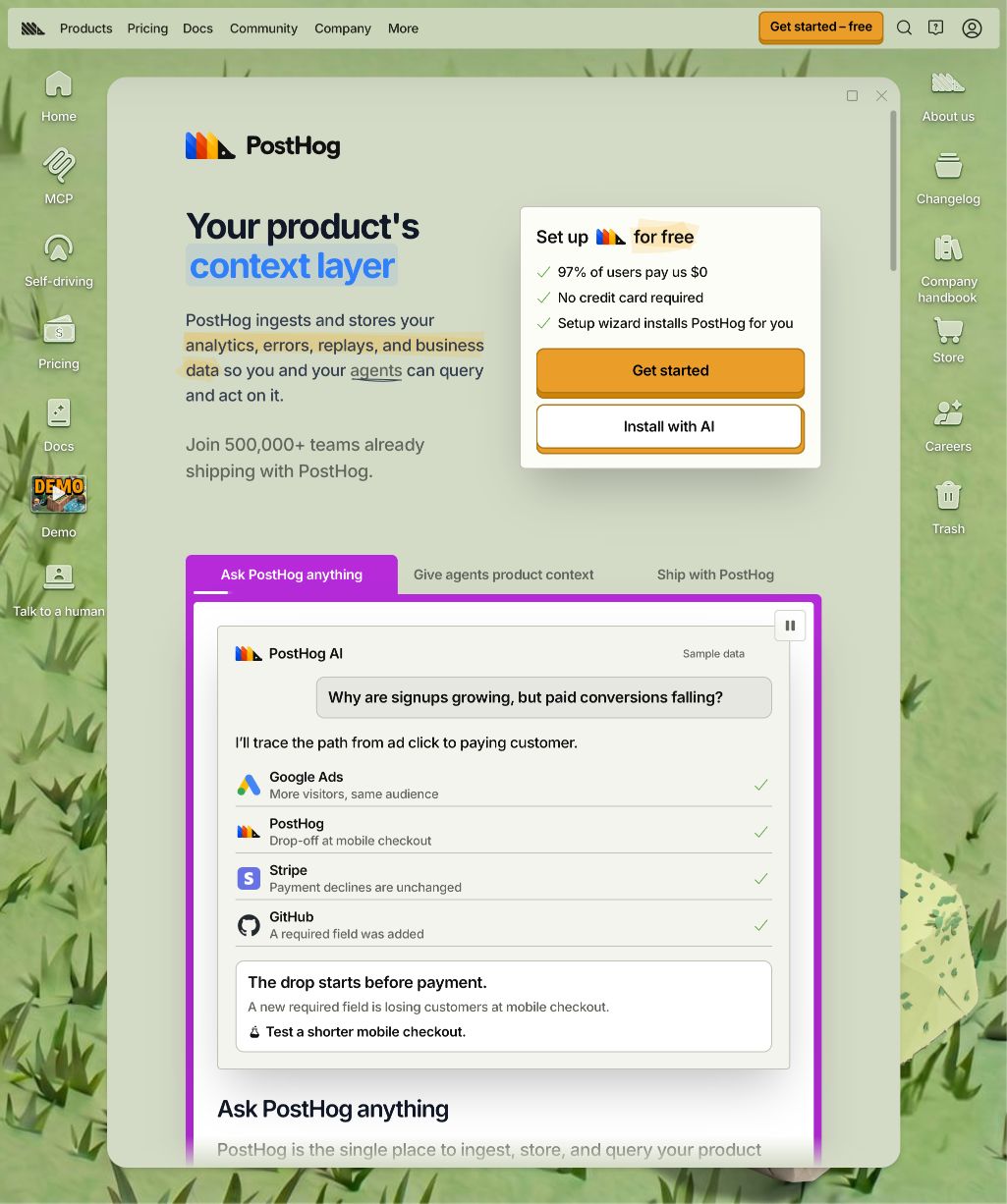
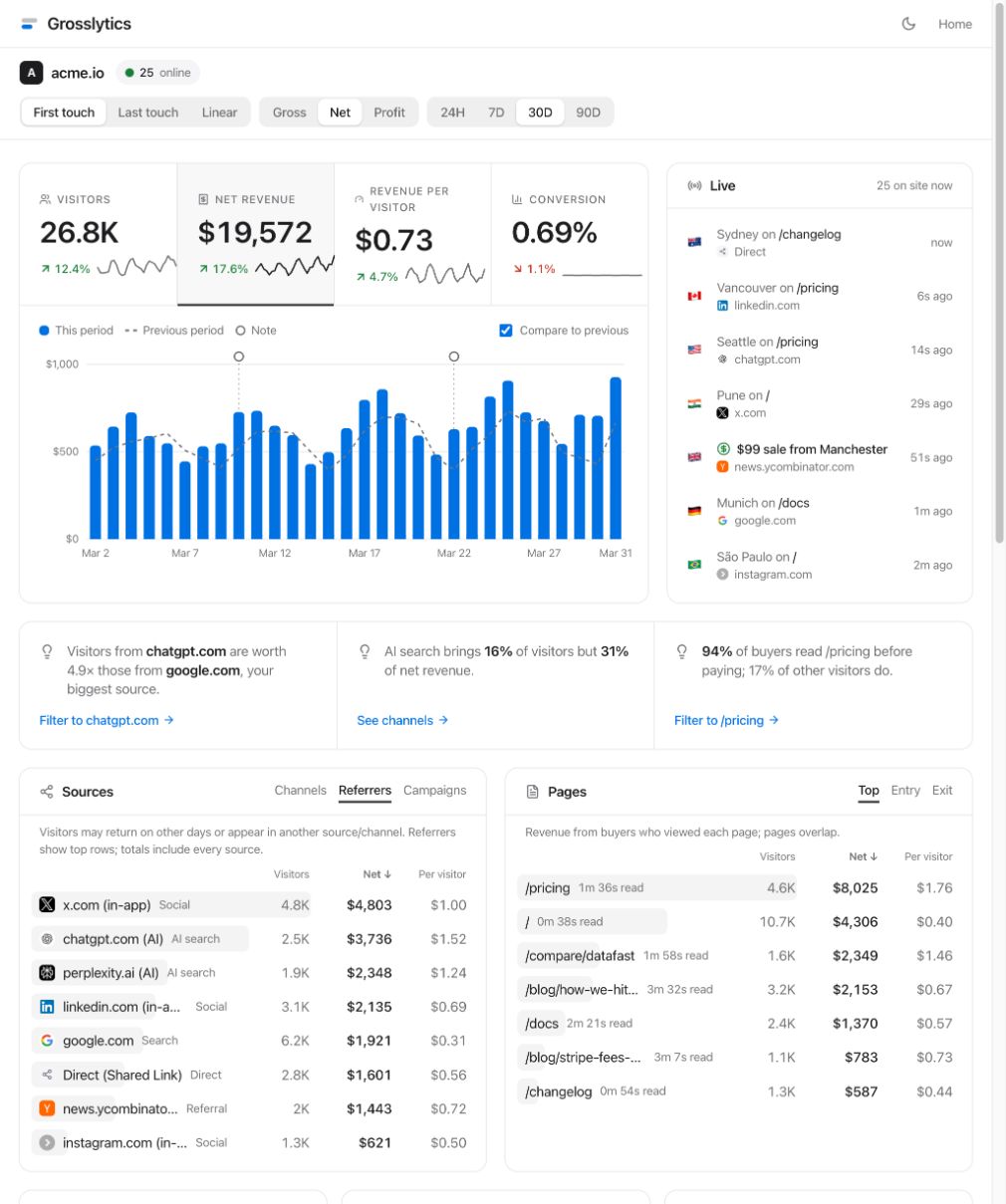
These screenshots show the public interfaces available on November 8, 2026.
PostHog
Grosslytics
Does PostHog force you to write HogQL for revenue reporting?
No: its current documentation describes revenue properties available through insights, SQL, managed views and profiles.
The dedicated Revenue analytics dashboard has been removed, so an old screenshot may not represent the present workflow. That change means you should test the reporting interface, rather than assume either a ready-made dashboard or a mandatory SQL project. Source: current revenue analytics documentation.
PostHog’s payment-platform guide currently supports Stripe as a revenue data source, with other listed platforms marked as coming soon. Existing PostHog users should evaluate that path before introducing another tracking system.
What do the script-size numbers actually prove?
Our local measurement establishes the size of one Grosslytics build, not a universal size ratio against PostHog.
On November 8, 2026, the main tracker built to 3,257 bytes raw and 1,580 bytes with Brotli quality 11, approximately 3.18 KiB and 1.54 KiB respectively. Reproduce it using the Grosslytics repository:
bun install
bun run --cwd packages/tracker build
The optional click-map script is separate. A fair size comparison would require equivalent builds and configurations.
PostHog exposes configuration controls for autocapture, session recording and other behavior. Those choices matter when evaluating your actual deployment. Source: JavaScript configuration.
For a fair measurement:
- Record exact SDK versions and production builds.
- Fix the enabled features for each candidate.
- Report raw bytes and compressed transfer bytes separately.
- Include resources loaded after initialization.
- Measure execution time and requests on the same page and device.
Is a smaller analytics product necessarily cheaper?
No: a free allowance can make the broader product less expensive in software charges at your current usage.
For a hypothetical workload of 80,000 pageviews and 20,000 custom events, the basic analytics count is 100,000 events. That fits PostHog’s published one-million-event free analytics allowance and Grosslytics’ listed hosted allowance, assuming those are the actual events recorded.
monthly_events = 80000 + 20000 = 100000
grosslytics_hosted_annual = 12 * 5.99 = 71.88
posthog_analytics_event_charge_within_free_allowance = 0
This is not a complete PostHog quote: data sources, recordings and other products have separate allowances and meters. Additional capture behavior can also change event volume, so price the implementation you will actually deploy.
Grosslytics source self-hosting avoids a software subscription, but infrastructure and your operating time remain. The point of a focused dashboard is reduced reporting work if it matches your needs, rather than a guaranteed lowest bill.
What revenue and attribution limits should you expect?
A focused dashboard still needs explicit definitions for fees, identity and subscription payments.
Grosslytics estimates Stripe fees using a configured schedule and subtracts ad spend you enter or import. Its profit view excludes payroll, hosting and other operating costs; full Stripe refunds are handled, but partial Stripe refunds are not automatically deducted.
Its attribution choices are first touch, last touch and a 50/50 split between those endpoints. That does not distribute credit across every intermediate visit.
Grosslytics exposes recorded payments and renewal attribution, rather than a normalized MRR engine. It recognizes source and campaign evidence when available; it does not recover an exact AI search query that the referring service did not send.
How should you trial lightweight revenue analytics?
Trial the required report and payment lifecycle before changing an existing product analytics setup.
- Write down one source-to-payment question.
- Configure visitor metadata using the payment guide.
- Complete a checkout from a tagged source.
- Check a renewal, a full refund and a partial refund.
- Reconcile source revenue and estimated fees with provider records.
- Decide whether keeping product analytics alongside attribution is useful.
No 90-second setup guarantee is made: deployment, checkout metadata and reconciliation take different amounts of work across applications. See the self-hosting guide if you plan to operate the service yourself.
A focused tool is worthwhile when it answers the required report with less ongoing work. Next, run one real payment lifecycle through your candidate and inspect the resulting source report.
Frequently asked questions
Can PostHog track Stripe revenue?
Yes. Its payment-platform documentation supports Stripe data, and revenue can be analyzed through available reporting surfaces. Review source usage charges and identity matching for your setup.
Is Grosslytics always cheaper than PostHog?
No. PostHog includes one million free analytics events per month, while Grosslytics’ hosted plan lists $5.99/month for 100,000 events. Compare all required products, infrastructure and reporting work.
Is Grosslytics a full replacement for PostHog?
Only if your requirements fit its narrower scope. Grosslytics does not offer equivalent session replay, experimentation or feature-flag capabilities.
Can Grosslytics reveal every AI search query that caused a sale?
No. It can report source and campaign information available to the tracker and payment attribution, but cannot recover a query that was never supplied by the referring service.