I’d keep Plausible if its purchase-event attribution and privacy-oriented website reporting answer your question. I’d consider Grosslytics when you need supported provider webhooks, renewal attribution and revenue after estimated fees. Plausible already tracks revenue, so the distinction is how much of the payment lifecycle you need to follow.
Key takeaways
- Plausible revenue tracking belongs to its Business plan; compare the required plan and usage tier rather than its lowest headline price.
- Grosslytics matches supported payment webhooks to visitor metadata and reports recorded renewal revenue, full Stripe refunds and observed LTV by first source.
- Grosslytics lists $5.99/month for 100,000 hosted events, with free source self-hosting and an optional $29 Lifetime license.
- Cash receipts, normalized MRR, observed LTV and business net profit are different metrics.
Does Plausible already track revenue?
Yes: Plausible offers revenue-enabled custom events, rather than only anonymous pageviews and button counts.
Its revenue documentation describes purchase amounts, currencies, source attribution and checkout-success integrations. It also states that payment-provider webhooks cannot be linked to the visit that led to payment, which is the relevant distinction for background subscription charges.
Grosslytics is our product. This comparison draws on vendor documentation checked on November 8, 2026, and the Grosslytics implementation; the recommendations reflect the use cases described below.
If a completed purchase event already answers your ecommerce question, adding a payment ledger may create unnecessary work. If you need renewals arriving without a browser visit, define that requirement explicitly.
How do Plausible and Grosslytics differ?
Plausible centers revenue-enabled website events, while Grosslytics centers supported provider webhooks joined to visitor identity.
| Requirement | Plausible | Grosslytics |
|---|---|---|
| Purchase revenue | Revenue goals and checkout-success events | Supported provider webhook handlers |
| Subscription charges without a visit | A payment-webhook-to-original-visit link is not supported in the documented workflow | Renewal attribution where visitor metadata and provider handling support it |
| Payment providers | Checkout event patterns include Stripe, Paddle, Lemon Squeezy and Polar | Native handlers include those providers plus Razorpay and others |
| Gateway fees | Revenue amount comes from the event you send | Stored fees deducted; Stripe fees estimated |
| Refund reporting | Validate a separate lifecycle reporting path | Full Stripe refunds remove payments from revenue; partial Stripe refunds not automatically deducted |
| Attribution model | Purchase event and visit context | First touch, last touch, or first-last endpoint split |
| Customer value | Validate your required customer-level report | Observed net receipts per customer, grouped by first source |
| Browser identity | No persistent identifiers advertised | Random visitor ID stored in localStorage |
| Hosting and pricing | Cloud plan and usage tier; revenue is Business | $5.99/month at 100k events; free source self-host; $29 Lifetime option |
Sources: Plausible product overview, Plausible plan definitions, Plausible revenue behavior, Grosslytics payments and dashboard definitions.
Grosslytics’ persistent visitor ID helps connect later payments, but that identity design is a meaningful change from Plausible. Cookie-free storage does not itself establish identical privacy behavior or consent requirements.
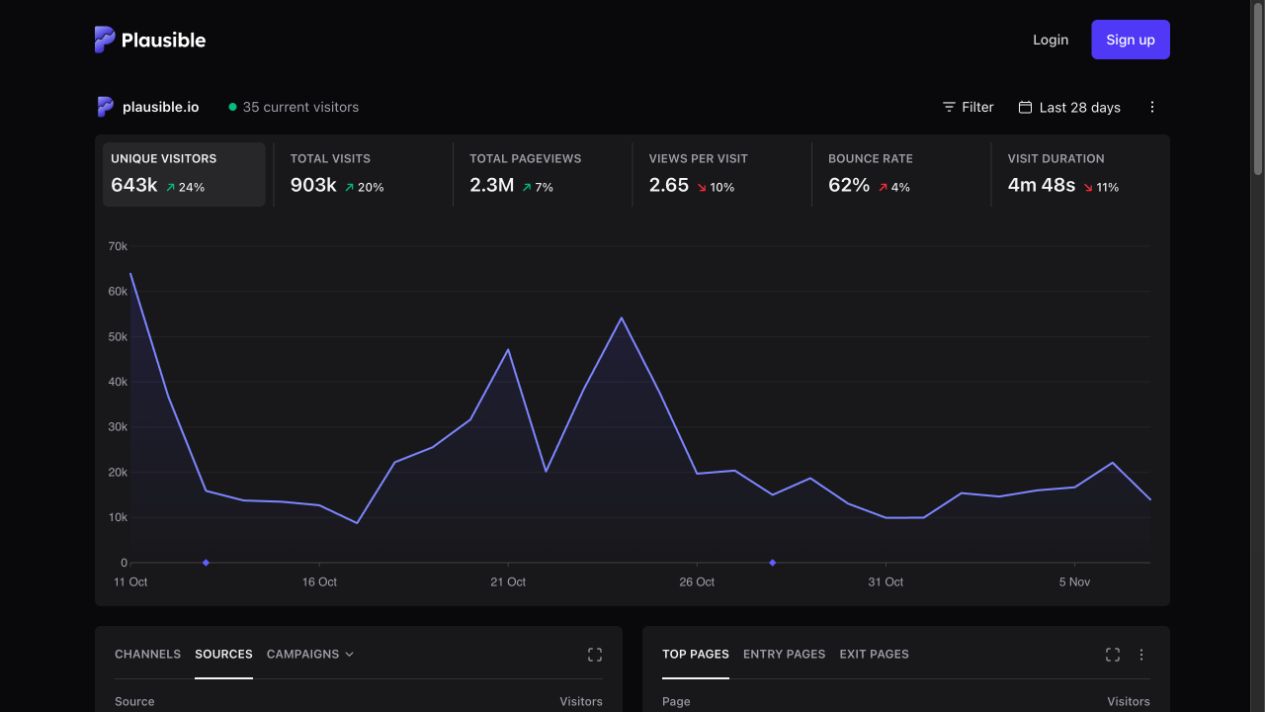
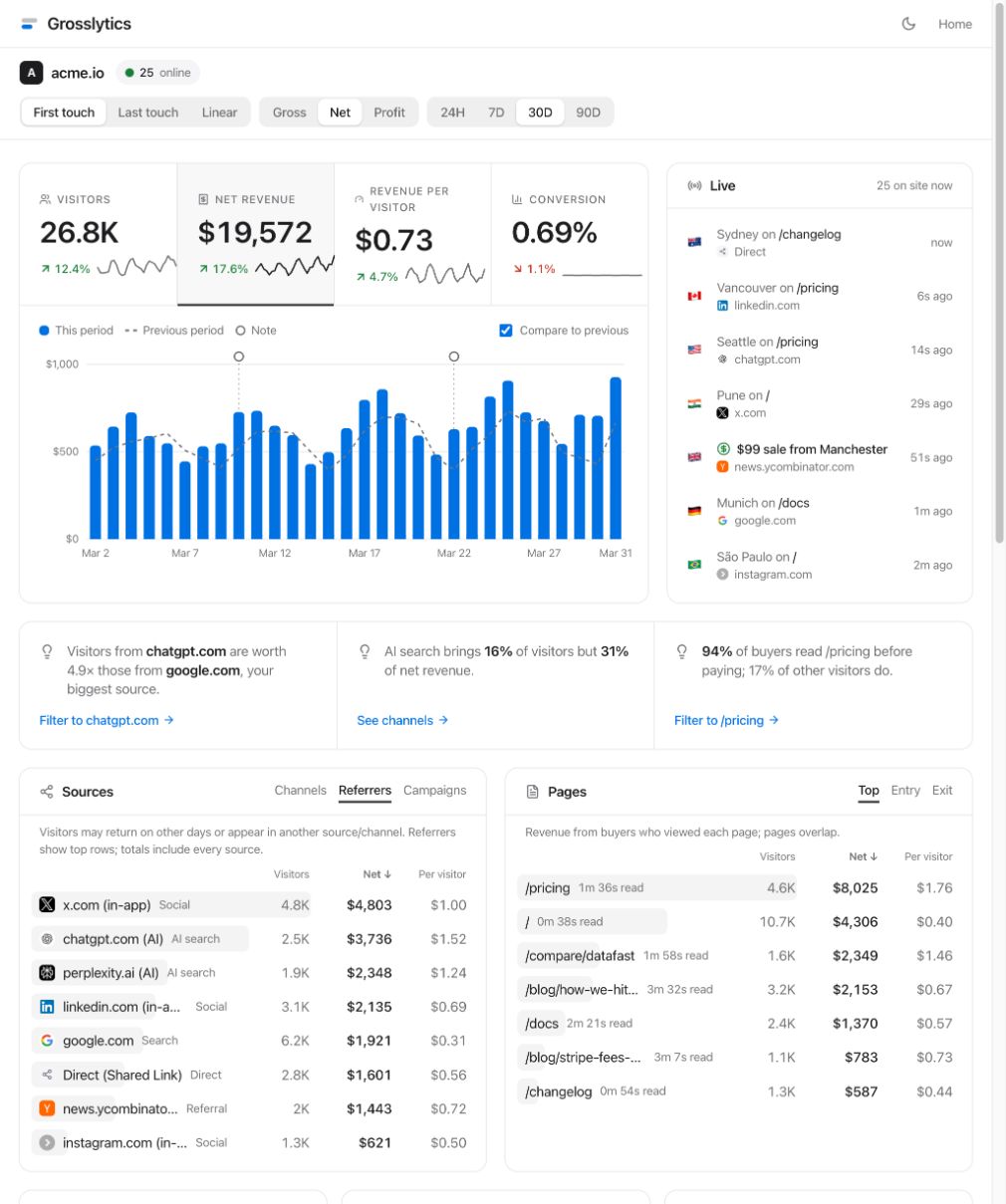
What do the public product pages look like?
These screenshots show the public interfaces available on November 8, 2026.
Plausible
Grosslytics
What happens when a subscription renews without a pageview?
A browser purchase event cannot describe a background renewal unless another integration sends the corresponding data.
Imagine a customer pays $30 through checkout and renews next month without opening your site. The initial purchase can generate a browser event; the renewal needs a separate server or provider event if it is to appear in payment reporting.
For Grosslytics, configure the visitor ID on the subscription as described in the Stripe setup instructions. A provider webhook without usable identity can record money without proving which marketing visit caused it.
That is a matching problem, not evidence that every renewal will automatically have perfect attribution. Test a real renewal and inspect the credited source.
Are renewal receipts the same as MRR?
No: normalized MRR describes recurring subscription value per month, while a payment ledger records charges as they arrive.
A hypothetical $1,200 annual plan illustrates the difference:
annual_subscription_charge = 1200
monthly_recurring_value = 1200 / 12 = 100
cash_received_on_charge_date = 1200
Calling all $1,200 “MRR” would overstate the monthly recurring value twelvefold. Grosslytics reports payments and renewal attribution, but does not calculate normalized subscription MRR.
Likewise, observed LTV is historical, rather than a prediction of future renewals. Grosslytics calculates all-time successful net receipts divided by distinct customers, grouped by first-touch source; it does not turn that into a forecast automatically.
How do fees and refunds change the comparison?
Fee and refund handling can change the revenue you attribute, but each integration needs its own reconciliation.
Grosslytics estimates Stripe fees using a configured schedule and subtracts ad spend you enter or import. Its profit view excludes payroll, hosting and other operating costs; full Stripe refunds are handled, but partial Stripe refunds are not automatically deducted.
For example, a $100 charge with an illustrative $3.20 fee leaves $96.80 before ad spend and operating costs. A full refund should change the revenue result; a partial refund requires amount-aware accounting and should be checked explicitly rather than assumed.
Use payment-provider settlement records as the reconciliation reference. A dashboard should explain its estimate and refund boundaries before you use it to compare acquisition channels.
What should you compare in the price?
Compare the plan that includes the required revenue feature, at the combined usage your implementation generates.
Plausible’s subscription documentation puts revenue tracking on Business and counts pageviews plus custom events toward usage. A low-tier traffic-only price is therefore not an equivalent quote for revenue tracking.
Grosslytics’ listed hosted plan is $5.99/month for 100,000 events, or $71.88 over twelve unchanged monthly payments. Its pricing also lists free source self-hosting and a $29 Lifetime option; infrastructure and operating effort remain separate for self-hosting.
How should you migrate without losing the revenue trail?
Run both systems long enough to verify the payment lifecycle before retiring either implementation.
- Export the Plausible reports you need to retain.
- Keep a known campaign URL and record a test visitor’s path.
- Configure the Grosslytics tracker and provider metadata.
- Verify the initial charge, renewal and source.
- Check full and partial refunds separately.
- Compare matching dates, currency, time zone and attribution definition.
The migration guide documents compatibility for selected goal attributes and JavaScript calls. That does not imply a historical data import or compatibility with every revenue-event payload, and no two-minute migration time is promised.
Keep Plausible when its purchase-event reporting is sufficient; add or switch to webhook reporting when payment lifecycle questions justify it. Next, validate one subscription renewal and its source before removing the old tracker.
Frequently asked questions
Is Plausible only a pageview counter?
No. It supports custom events and Business-plan revenue tracking, with ecommerce purchase attribution. The relevant difference is how subsequent payments are recorded and linked to the original visitor.
Does Grosslytics report exact MRR and predicted LTV?
The current implementation reports payments, renewal attribution and observed historical LTV by first source. Do not treat that as normalized subscription MRR or predicted customer lifetime value.
Will my Plausible history move automatically?
No automatic historical migration is promised here. Export needed reports, check destination import support and validate future payments in parallel before switching.
Do Grosslytics refunds work the same for every gateway?
No. Full Stripe refunds are handled, but partial Stripe refunds are not automatically deducted. Test the provider and event types your business actually uses.