I’d choose between DataFast, DataBull and Grosslytics by first asking who should operate the software and which payment providers you use. DataFast is a managed revenue attribution service, DataBull is a proprietary self-hosted Cloudflare installation, and Grosslytics offers open-source self-hosting and reporting after estimated gateway fees and supplied ad spend. Those tradeoffs matter more than a universal feature winner.
Key takeaways
- Compare DataFast at your actual event volume and billing selection; a starting price is not a fixed bill at every traffic level.
- DataBull offers a $49 self-hosted license plus infrastructure, with a hosted beta also available.
- Grosslytics lists $5.99/month for 100,000 hosted events, free source self-hosting and a $29 Lifetime option.
- Compare the specifications and cost scenarios against the traffic and integrations you expect to use.
What are we comparing?
We compare purchase terms, payment integration and reporting behavior for a founder choosing a revenue attribution tool.
Grosslytics is our product. This comparison draws on vendor documentation checked on November 8, 2026, and the Grosslytics implementation; the recommendations reflect the use cases described below.
The costs below are scenarios, and the tracker size comes from a local Grosslytics build; the three products were not performance tested.
How do the three tools compare across 12 criteria?
The largest practical differences are hosting responsibility, gateway coverage and how revenue is defined.
| Criterion | DataFast | DataBull | Grosslytics |
|---|---|---|---|
| 1. Operating model | Managed service | Self-hosted Cloudflare; hosted beta | Self-hosted Cloudflare or managed cloud |
| 2. Purchase model | Volume-based subscription | $49 self-hosted license; hosted subscription | Free source self-host; $29 Lifetime; $5.99/month cloud |
| 3. Usage allowance | Event-tier dependent | Self-host license: unlimited events; hosted plans have allowances | Cloud: 100k events/month; own infrastructure limits self-hosting |
| 4. Native payment providers | Stripe, Lemon Squeezy, Polar, Shopify | Stripe, Polar, Dodo, Creem | Stripe, Paddle, Razorpay, Polar, Lemon Squeezy, Cashfree, Gumroad, PayPal, Dodo, RevenueCat |
| 5. Other payment paths | Payment API | Payments API | Listed provider-specific handlers; review checkout metadata |
| 6. Attribution | Revenue by source and customer journey | First, last and last non-direct | First, last and 50/50 first-last endpoint split |
| 7. Fee deductions | Verify required fee definition | Verify required fee definition | Stored gateway fees; Stripe fees are estimated |
| 8. Ad spend | Verify workflow and plan | Verify workflow and plan | Entered or CSV-imported spend |
| 9. Social mentions | Growth documents X and Reddit mentions | Do not assume equivalent monitoring | No equivalent social-mention monitor claimed |
| 10. Browser identity | Cookie script and optional cookieless script | Cookie, cookieless or consent-dependent mode | Random visitor ID in localStorage |
| 11. Agent access | API, CLI, MCP | API, CLI, MCP | API and MCP |
| 12. Source availability | Managed product evaluated here | Proprietary; source not included | Open-source self-hosting available |
Sources: DataFast features and plans, DataBull product and purchase terms, DataBull attribution, DataBull payment setup, Grosslytics payment documentation and dashboard definitions.
“Verify” means the reviewed evidence does not establish that requirement, rather than a finding that the product cannot support it. The gateway count also does not establish equal refund coverage or integration maturity.
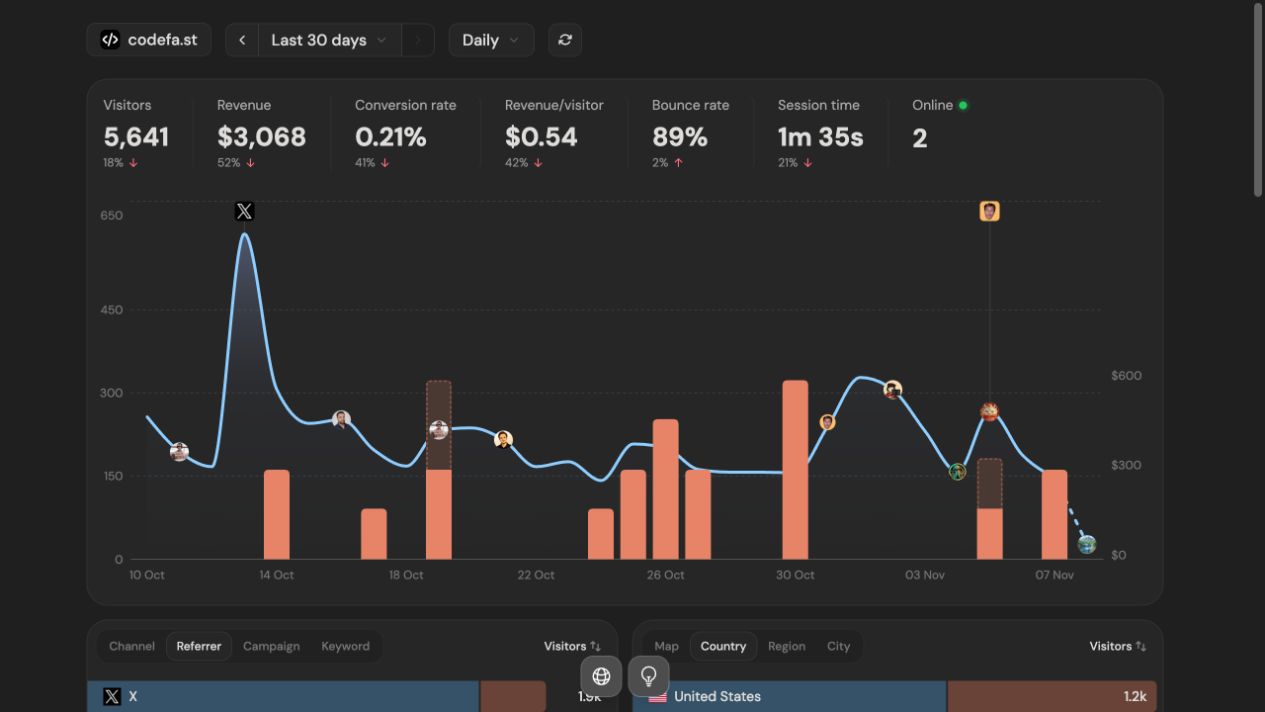
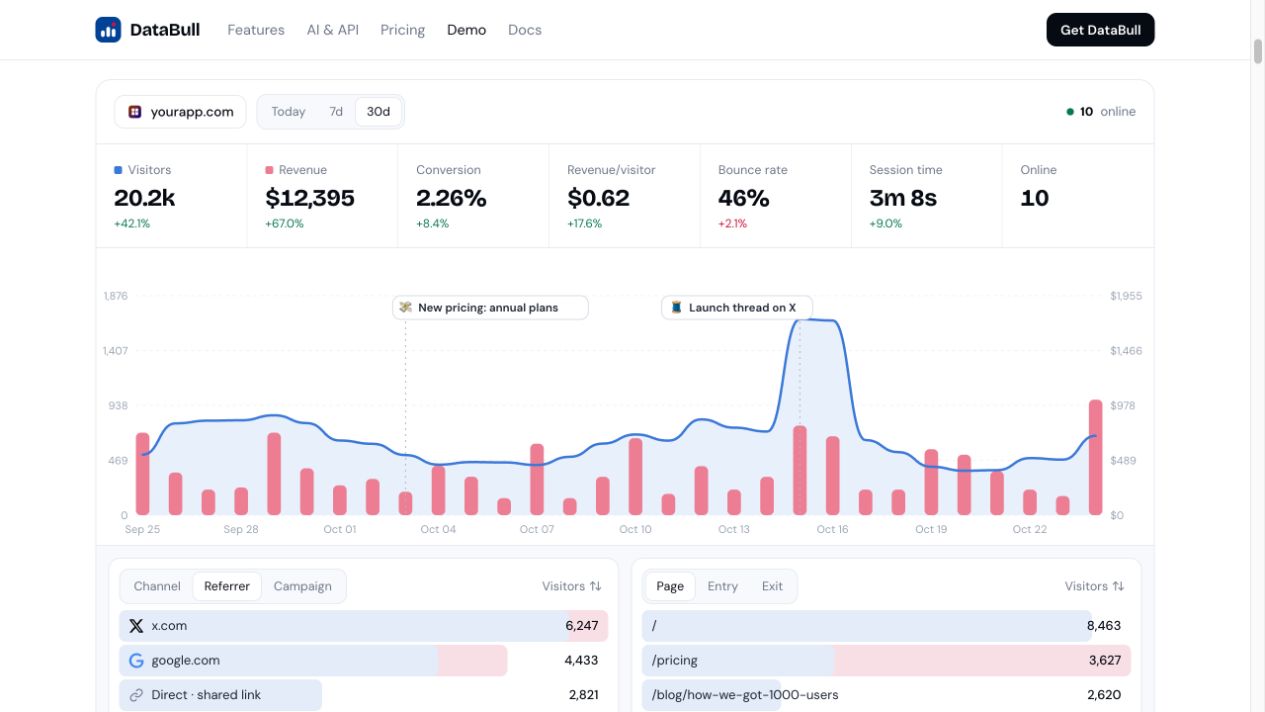
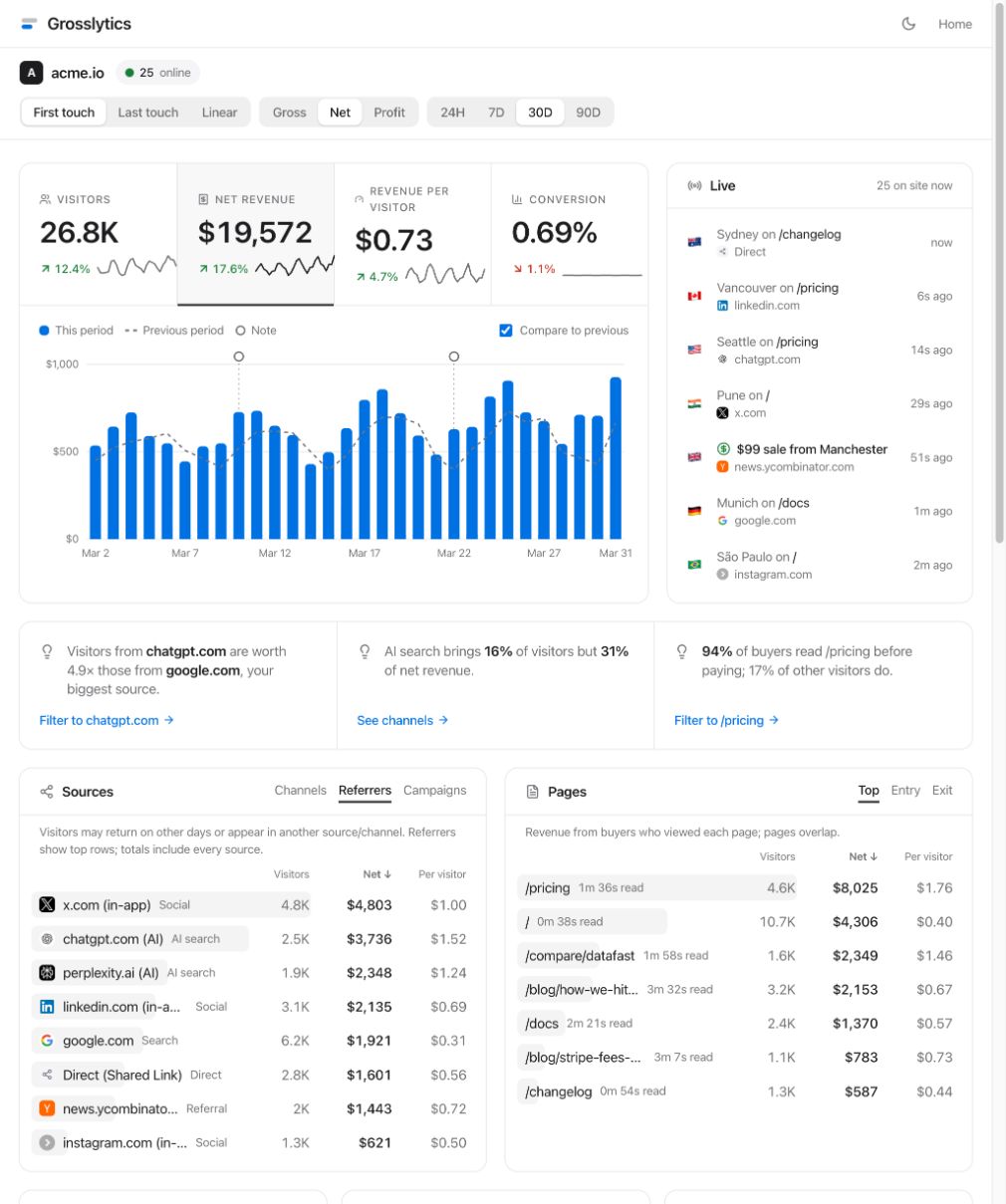
What do the public product pages look like?
These screenshots show the public interfaces available on November 8, 2026.
DataFast
DataBull
Grosslytics
What could you pay over twelve months?
Annual cost is the software bill plus infrastructure and operating work, using a traffic tier that actually fits.
The following are USD scenarios, excluding taxes and staff time. They assume unchanged monthly prices; discounts, renewals and usage overages can change the total.
| Scenario | Calculation | Software or assumed hosting total |
|---|---|---|
| DataFast at an assumed $9 monthly quote | 12 × $9 | $108 |
| DataFast at an assumed $19 monthly quote | 12 × $19 | $228 |
| DataBull self-host, infrastructure stays free | $49 + $0 | $49 |
| DataBull self-host, assumed $5/month infrastructure | $49 + 12 × $5 | $109 |
| Grosslytics Cloud within its 100k-event allowance | 12 × $5.99 | $71.88 |
| Grosslytics Lifetime, assumed $5/month infrastructure | $29 + 12 × $5 | $89 |
| Grosslytics source self-host, infrastructure stays free | $0 + $0 | $0 |
annual_cost = license + 12 * monthly_subscription + infrastructure
grosslytics_cloud = 0 + 12 * 5.99 + 0 = 71.88
self_host_example = 29 + 0 + 12 * 5 = 89
The $9 and $19 DataFast rows are illustrative monthly quotes, not promises at 100,000 events or every billing selection. Confirm the selected traffic tier and billing cadence in its pricing interface before comparing with Grosslytics’ 100,000-event offer.
The assumed $5 infrastructure rows are arithmetic examples, not complete Cloudflare quotes. Inspect Workers, database, storage and other service usage; Cloudflare D1 pricing explains database billing, while DataBull’s free-plan guide describes its deployment costs.
Which revenue number are you trying to optimize?
Choose whether you need attributed payments, revenue after fees or a contribution measure after ad spend.
Grosslytics estimates Stripe fees using a configured schedule and subtracts ad spend you enter or import. Its profit view excludes payroll, hosting and other operating costs; full Stripe refunds are handled, but partial Stripe refunds are not automatically deducted.
DataBull already offers multiple single-touch models and renewal attribution. Grosslytics’ mode named linear splits credit between first and last source; it does not weight every touch in a complete customer journey.
Recorded subscription payments also differ from normalized MRR. A $1,200 annual subscription can generate $1,200 of cash receipts on one day while representing $100 of monthly recurring value; do not infer an MRR dashboard from payment attribution alone.
What did we actually measure about script size?
The current local Grosslytics build produced a 3,257-byte main tracker, or 1,580 bytes with Brotli quality 11, on November 8, 2026.
That is approximately 3.18 KiB raw and 1.54 KiB compressed, rather than the proposed 1.14 KB claim. The optional click-map script is separate and is not included in the main-tracker number.
Reproduce the local build from the Grosslytics source:
bun install
bun run --cwd packages/tracker build
This measurement does not establish a speed winner. A fair comparison also needs fixed competitor SDK versions, enabled features, compression and all loaded resources; no comparable DataFast or DataBull measurement is claimed here.
What does switching actually preserve?
Grosslytics recognizes selected goal calls and checkout metadata from DataFast and DataBull, but that is not full data or API compatibility.
The migration documentation describes existing goal attributes and calls, plus visitor metadata aliases. Historical attribution, visitor identifiers, provider setup and every custom API integration still need their own validation.
Before switching:
- Price the same expected event workload.
- Test your actual checkout and visitor metadata.
- Inspect renewal attribution.
- Check full and partial refunds.
- Confirm export and retention requirements.
Select the product that fits both the payment stack and the operating model. Next, run one payment lifecycle through your preferred candidate and reconcile it with the provider’s records.
Frequently asked questions
Is DataBull cheaper than DataFast?
It can be if its one-time self-hosted license replaces an ongoing subscription and your infrastructure costs stay low. Include Cloudflare usage, maintenance and the exact DataFast traffic tier in the comparison.
Does Grosslytics calculate true net profit?
Its profit mode subtracts stored gateway fees and supplied ad spend. It does not include every operating expense, and Stripe fees are estimated, so the result is not complete business net profit.
Is this a live Cloudflare D1 benchmark?
No. It is a specification comparison, annual-cost scenario analysis and a measured local Grosslytics tracker build. Live database latency and throughput were not tested.